

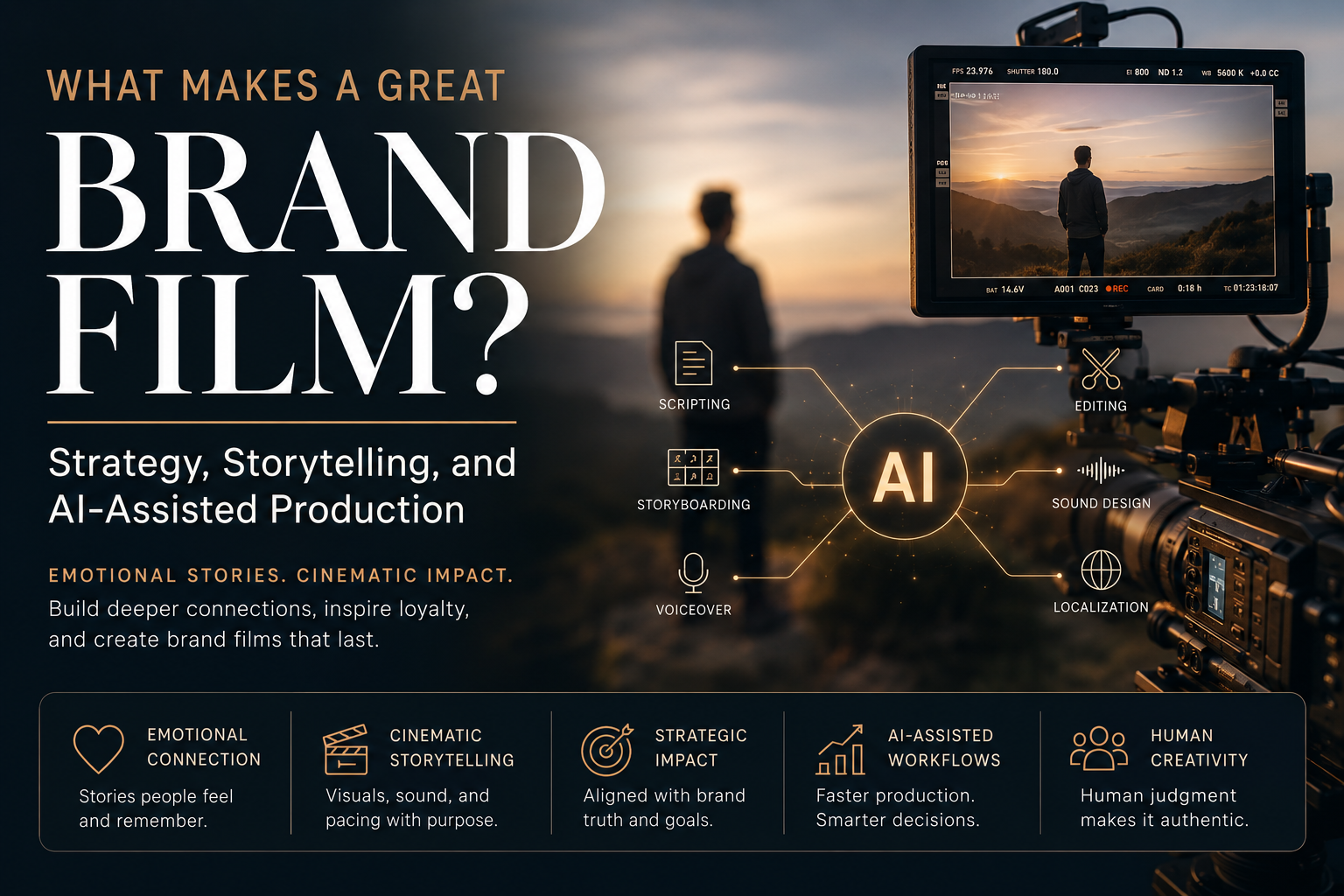
Brand films are not product demos. They are cinematic stories designed to make people feel something meaningful about your brand.
A great brand film does three things at once: it communicates who you are, creates emotional connection, and gives your audience a reason to remember you. It may not ask for the sale directly, but it shapes how people think, feel, and respond when they encounter your brand again.
That is why brand films matter now. Audiences are overwhelmed by short-form ads, performance campaigns, and product-led content. The brands that break through are often not the loudest. They are the ones with a clearer story, a stronger visual identity, and a more memorable emotional world.
AI-assisted production is making this kind of cinematic storytelling more accessible. Tools now support script development, storyboarding, visual exploration, editing, captioning, localization, and versioning. Google has described generative AI as a way to unlock new possibilities across the marketing process, including creative asset development at scale.
But AI is not the strategy. It is not the director. It is not the emotional core of the film.
The best brand films still depend on human taste, creative judgment, and a clear brand truth.
What Is a Brand Film?
A brand film is a short cinematic video that tells a story about a brand’s identity, values, mission, audience, or point of view.
Unlike a traditional advertisement, a brand film does not usually lead with features, pricing, or a hard sales message. Instead, it creates emotional meaning around the brand.
A brand film might tell the story of:
- A founder’s vision
- A customer transformation
- A cultural belief the brand stands for
- A problem the audience deeply understands
- A mission larger than the product
- A human moment the brand quietly enables
The product may appear, but it is rarely the main character. The emotional idea is.
Brand Film vs. Corporate Video: What Is the Difference?
Corporate videos inform. Brand films move.
That distinction matters because the two formats serve different business goals.
A corporate video can tell people what your company does. A brand film helps them understand why they should care.
Why Brand Films Work
Brand films work because people remember stories more easily than isolated claims.
Emotional brand-building has long been treated as a different discipline from short-term sales activation. The IPA’s work with Les Binet and Peter Field helped popularize the distinction between long-term brand building and short-term activation in marketing effectiveness. System1 has also reported that emotional response can be used to predict commercial impact in both short- and long-term advertising contexts.
For brand films, this matters because the goal is not always immediate conversion. The goal is memory, meaning, affinity, and trust.
A strong brand film can help:
- Introduce a brand to a new audience
- Reposition a business in a more premium category
- Support investor, recruitment, or partnership conversations
- Strengthen emotional loyalty with existing customers
- Give performance marketing a stronger brand world to draw from
- Create an evergreen asset that outlives a campaign window
A product ad may win the click. A brand film can shape the reason people click later.
The Creative Foundation: One Brand Truth
A brand film without a clear creative strategy becomes an expensive mood video.
Before production begins, the team needs one central truth.
Not a slogan. Not a campaign line. A truth.
Examples:
- “We help ambitious founders look as serious as they feel.”
- “We exist for people who refuse to make ordinary work.”
- “We turn invisible craft into visible value.”
- “We help customers feel ready for the moment that matters.”
That truth becomes the anchor for every creative decision: casting, location, pacing, lens choice, music, editing rhythm, colour grade, and final line.
Without that anchor, the film may look beautiful but feel empty.
What Makes a Brand Film Cinematic?
Cinematic quality is not only about expensive cameras. It is about intentional choices.
A cinematic brand film uses visual language to communicate identity before the audience hears a sales message.
A premium brand film feels deliberate. Every frame should tell the audience something about the brand, even without the logo.
Narrative Arc: The Structure Behind an Effective Brand Film
The most effective brand films usually follow a simple emotional arc:
- The world as it is Show the audience a familiar reality, frustration, desire, or tension.
- The human tension Reveal what is at stake emotionally, not just commercially.
- The shift Introduce the brand’s belief, product, service, or role as part of the transformation.
- The resolution Leave the audience with a feeling: confidence, relief, ambition, belonging, wonder, or trust.
- The memory cue Close with a distinctive visual, phrase, sound, or brand moment that lingers.
This structure prevents the film from becoming a montage. It gives the audience a reason to keep watching.
AI-Assisted Production: What Changes for Brand Films?
AI-assisted production changes the speed and flexibility of the brand-film process.
It can help teams move faster through concepting, scripting, visual exploration, transcription, editing, captioning, resizing, localization, and campaign versioning. McKinsey has reported that AI is already being examined across the film and TV production value chain, from previsualization to postproduction.
For brand films, the practical advantage is not “replace the crew.” It is “reduce friction around the crew.”
AI can help with:
AI can generate options. The creative team must decide what is worth keeping.
The Human-in-the-Loop Model
The strongest AI-assisted brand films use a human-in-the-loop workflow.
That means AI supports the process, but humans retain control over the decisions that define the work.
A director still owns the emotional arc.A strategist still owns the audience insight.An editor still owns the rhythm.A producer still owns the feasibility.A brand lead still owns the final meaning.
Adobe has emphasized that AI can support brand storytelling when brand direction and message integrity are defined upfront. That principle is critical for brand films. If the brand does not know what it wants to say, AI will only help it say something generic faster.
Protecting Brand Voice When Using AI
The biggest risk of AI-assisted content is not bad visuals. It is sameness.
AI tools tend to produce familiar patterns unless they are guided by strong creative constraints. Brands that use AI without guardrails risk creating content that looks polished but feels interchangeable.
Before using AI in a brand film workflow, define:
- Approved visual references
- Tone-of-voice principles
- Words and phrases the brand avoids
- Colour and lighting preferences
- Music and pacing references
- AI use cases that are allowed
- AI use cases that require legal or senior creative review
- Final approval responsibilities
This protects the brand from becoming another piece of synthetic content in the feed.
Ethical and Legal Considerations for AI Brand Films
AI-assisted production creates new questions around authorship, likeness, consent, copyright, and transparency.
The U.S. Copyright Office has issued guidance for works containing AI-generated material, so brands using AI-generated assets should review copyright implications before commercial publication.
In the EU, AI Act transparency rules are scheduled to come into effect in August 2026, and the European Commission states that certain AI-generated content, including deepfakes, should be clearly labelled.
Brands should also consider provenance tools. C2PA describes Content Credentials as a standard that functions like a “nutrition label” for digital content, helping people inspect content history and origin.
A practical AI brand-film checklist should include:
This article is informational and should not be treated as legal advice. Brands using AI-generated people, voices, performances, or synthetic footage should involve legal review before publication.
How Long Should a Brand Film Be?
Most brand films work best between 60 seconds and five minutes, depending on purpose and channel.
The right length is not the shortest possible version. It is the shortest version that preserves the emotional arc.
How to Brief a Brand Film Production Partner
A good brand film starts with a sharp brief.
Include:
- The business objective What should this film help achieve?
- The audience Who needs to feel something after watching?
- The emotional target Should they feel inspired, reassured, excited, understood, or challenged?
- The brand truth What belief sits underneath the story?
- The distribution plan Where will the film live: website, social, paid media, events, investor decks?
- The required deliverables Hero film, cutdowns, vertical edits, thumbnails, captions, stills, trailers.
- The AI boundaries What can AI assist with, and what must remain human-created?
The clearer the brief, the stronger the film.
How to Measure Brand Film Success
Brand films should not be judged only by last-click conversions.
A better measurement framework includes:
Brand films often create value across the full marketing system. They strengthen the world around the product, which can improve how every other asset performs.
Brand Films in the AI Search Era
Optimizing a brand-film article for AI search does not require secret markup or an “AI-only” SEO tactic.
Google says its existing SEO best practices still apply to AI features such as AI Overviews and AI Mode. Google has also stated that publishers do not need special machine-readable AI files or new markup to appear in generative AI search features.
For this page, the best approach is to make the content genuinely useful:
- Define “brand film” clearly.
- Explain how it differs from corporate video.
- Use comparison tables.
- Answer practical buyer questions.
- Include production checklists.
- Cite reliable sources.
- Avoid exaggerated AI claims.
- Make the CTA relevant and honest.
Clear, structured, source-backed content is more likely to be useful for both human readers and AI answer systems.
Key Takeaways
A brand film is a cinematic story that communicates what a brand stands for, not just what it sells.
The best brand films are built around one clear emotional truth.
Corporate videos explain. Brand films create memory.
AI-assisted production can reduce friction, speed up workflows, and make cinematic storytelling more accessible, but it cannot replace creative strategy, taste, or emotional judgment.
Brands using AI in production need clear guardrails for voice, rights, consent, disclosure, and final approval.
A great brand film is not just content. It is a long-term brand asset.
Ready to create a brand film that feels cinematic, strategic, and unmistakably yours? Start with the story your audience needs to feel — then build the production around that truth.